
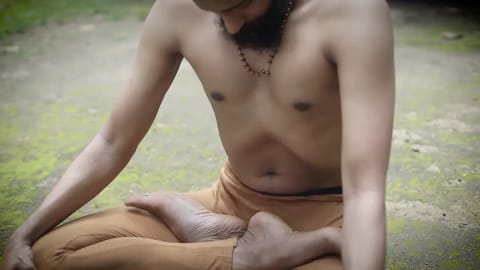
For many people in Europe and increasingly in Indian cities too, "yoga" means a class: mats, stretching, perhaps a few minutes lying still at the end. That is a real and valuable part of yoga. But it is only one part. Understanding the bigger picture often changes how people practise, and it shows why yoga and meditation belong together.
Patanjali's definition
The Yoga Sūtras of Patanjali, a compact text of 196 aphorisms, opens with a definition in its second sutra (1.2):
Yogaś citta-vṛtti-nirodhaḥ
Citta is the mind-field, vṛtti its fluctuations or movements, and nirodha stilling or restraint. Yoga, in this classical sense, is the stilling of the movements of the mind. Not flexibility, not fitness, but a quiet, clear mind.
The Platonix session Raja Yoga: Training the Mind took this sutra as its starting point, asking what Patanjali actually means by yoga and how we can train the mind rather than simply try to control it. The channel The Dynamics of Dhyana, whose very tagline is "chitta vritti nirodh", explores the same question in its Hindi-language episode What is Yoga?.
The eight limbs
Patanjali sets out a path of eight limbs (aṣṭāṅga):
- Yama: ethical restraints, such as non-violence and truthfulness.
- Niyama: personal disciplines, such as cleanliness, contentment and self-study.
- Āsana: a steady, comfortable posture.
- Prāṇāyāma: regulation of the breath and vital energy.
- Pratyāhāra: withdrawal of the senses from their objects.
- Dhāraṇā: concentration on a single point.
- Dhyāna: meditation, an unbroken flow of attention.
- Samādhi: absorption.
Notice that postures are third, and meditation seventh. The postures and breathing are not the goal; they prepare the body and nervous system so that sitting still becomes possible. Patanjali's own description of asana (2.46) is simply sthira sukham āsanam: posture should be steady and comfortable.
Four great paths
Beyond Patanjali, Indian tradition, and the Bhagavad Gita in particular, speaks of several yogas or paths to the same goal:
- Karma yoga: the path of selfless action.
- Bhakti yoga: the path of devotion.
- Jñāna yoga: the path of knowledge and self-inquiry.
- Rāja yoga (or dhyāna yoga): the path of meditation and mental discipline, closely associated with Patanjali.
Chapter 6 of the Gita is called Dhyāna Yoga, the yoga of meditation. A Jiva Balance talk on this chapter (Day 134) describes it as one of the most practical and psychological chapters: how to control the mind, how to meditate, how to balance life. Hatha yoga, the physical discipline most people meet in classes, is traditionally seen as a preparation for these deeper paths.
So where does meditation fit?
Meditation is not separate from yoga; it is one of its central limbs. A complete practice naturally moves from outer to inner:
- Body (asana) releases tension and builds the stability to sit.
- Breath (pranayama) calms and steadies the nervous system.
- Senses (pratyahara) quieten as attention turns inward.
- Mind (dharana, dhyana) settles on one point and then rests in it.
This is why many teachers end a posture class with breathing and a few minutes of sitting. It is not an add-on but the direction the whole practice is pointing.
A simple combined practice (25 minutes)
- Asana (12 minutes): a gentle sequence such as neck and shoulder movements, cat-cow, a standing forward bend, a few lunges, a seated twist and child's pose.
- Rest (2 minutes): lie in shavasana and feel the body.
- Pranayama (5 minutes): sit up and practise slow alternate-nostril breathing, without breath retention.
- Meditation (6 minutes): rest attention on the breath or a mantra, gently returning whenever the mind wanders.
Even this short sequence shows how each stage makes the next easier.
Training the mind rather than controlling it
The phrase from the Raja Yoga session description, training the mind rather than simply trying to control it, points to something important. Forcing the mind to be quiet rarely works. Patanjali's own pair of tools in sutra 1.12 is abhyāsa (steady practice) and vairāgya (non-attachment): returning again and again, while gradually letting go of what pulls the mind away. That is closer to training a young animal with patience than to locking it in a cage.
In practice this means regularity over intensity, kindness over force, and a willingness to begin again each time the mind wanders.
Common misunderstandings
- "I'm not flexible enough for yoga." Flexibility is not the point. A steady, comfortable seat is.
- "Meditation is a different practice from yoga." Classically, it is the heart of yoga.
- "Yoga is a religion." Yoga arose within Indian spiritual traditions and has deep philosophical roots, but its practices are offered openly to people of all backgrounds and beliefs.
- "More intense is better." Patanjali asks for steadiness and ease, not strain.
A note on safety
Physical postures and breathing practices should feel comfortable. If you have health conditions, injuries or are pregnant, consult a qualified professional and practise under guidance.
Explore the whole of yoga
On Platonix you can watch the Raja Yoga: Training the Mind session for an introduction to Patanjali, listen to the Jiva Balance talk on Gita Chapter 6 on meditation, or see a short introduction to hatha yoga from the Nath Yoga channel, then join a live session to practise body, breath and mind together.