
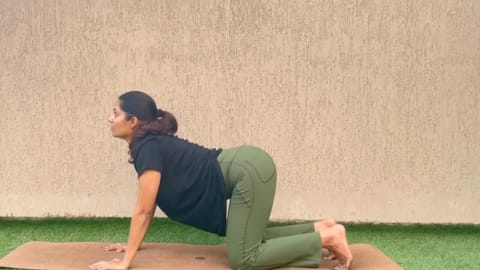
If you work at a laptop, you probably know the feeling: by late afternoon the neck aches, the shoulders creep up towards the ears and the upper back feels like a single stiff plate. Yoga cannot change your job, but it can give your body a regular chance to undo the shape the day has pressed it into.
Why desks stiffen us
A few patterns are almost universal:
- The head drifts forward towards the screen, so the muscles at the back of the neck work constantly to hold it up.
- The shoulders round forward and the chest closes.
- The upper back stays still for hours, so it loses its natural mobility.
- Stress adds tension. Deadlines and long calls often show up as clenched jaws and raised shoulders.
The goal of a desk-recovery practice is to reverse these gently: bring the head back over the shoulders, open the chest, mobilise the upper spine and release held tension.
A gentle flow (10–15 minutes)
Tatwika's Tight Shoulders & Stiff Neck? Try this Yoga Asana flow on Platonix is designed for exactly this. It is practised mostly kneeling and on all fours, so it is accessible to most people. The outline below follows the same spirit; move slowly and within a comfortable range.
1. Kneeling or seated centring (1 minute)
Sit on your heels (or on a cushion, or a chair). Lengthen the spine, rest the hands on the thighs and take a few slow breaths, letting the shoulders drop on each out-breath.
2. Gentle neck movements (2 minutes)
- Nods: slowly lower the chin towards the chest, then lift it to look gently upwards. Five times.
- Side bends: ear towards shoulder, hold for three breaths, then change sides.
- Half circles: chin down, roll the head slowly from one shoulder to the other along the front, never forcing backwards.
3. Shoulder rolls and shrugs (1 minute)
Lift the shoulders to the ears on an in-breath, drop them on an out-breath. Then roll them slowly backwards in big circles.
4. Cat and cow (2 minutes)
Come to all fours, hands under shoulders, knees under hips. Breathing in, let the belly lower and lift the chest and gaze (cow). Breathing out, round the spine and tuck the chin (cat). Move with the breath, eight to ten rounds. This mobilises the whole spine, including the stiff upper back.
5. Thread the needle (2 minutes)
From all fours, slide the right arm under the left, palm up, lowering the right shoulder and temple towards the mat. Breathe into the upper back for five breaths. Change sides.
6. Child's pose with arm reach (1 minute)
Sit back towards the heels, forehead down, arms stretched forward. Let the shoulders release.
7. Cross-body shoulder stretch (1 minute)
Kneeling or sitting upright, bring the right arm across the chest and hold it gently with the left forearm. Five breaths, then change.
8. Rest (1 minute)
Sit quietly or lie on your back for a few breaths, noticing how the neck and shoulders feel now.
Habits that help between sessions
Yoga is most effective when the day itself is a little kinder to your body:
- Screen at eye level. Raise a laptop on a stand or books and use a separate keyboard.
- Hourly micro-breaks. Stand, roll the shoulders, look into the distance for thirty seconds.
- Notice the shoulders. Several times a day, ask "where are my shoulders?" and let them drop.
- Breathe low. Shallow chest breathing goes with tension; a few slow belly breaths signal the body to ease.
For a longer practice after work, Tatwika's Post Work Yoga Flow ("Practice this if you sit a lot!") works the whole body, and Day 4 of her beginner series focuses on upper-body strength and mobility.
Safety notes
- Move slowly and stay in a pain-free range. Mild stretching sensation is fine; sharp, burning or shooting pain is a signal to stop.
- Avoid forcing the head backwards or doing fast full neck circles.
- If you have a neck or shoulder injury, numbness, tingling down the arm, dizziness, or have been told you have a disc or joint problem, consult a qualified health professional before practising and tell your teacher.
A two-minute desk version
When you cannot get to a mat, a short sequence on the chair still helps:
- Sit tall with both feet on the floor.
- Slowly lower the chin towards the chest and breathe into the back of the neck for three breaths.
- Tilt the right ear towards the right shoulder for three breaths, then the left.
- Interlace the fingers behind the back (or hold the chair seat) and gently open the chest for three breaths.
- Hug yourself, hands on opposite shoulders, and breathe into the upper back.
- Finish with five slow shoulder rolls backwards.
Done once an hour, this is often more effective than a single long stretch at the end of the day.
A small daily ritual
Ten minutes on the mat at the end of a working day can become a clear boundary between work and the rest of your life, as much for the mind as for the shoulders.
Practise along
Follow Tatwika's neck and shoulder flow on Platonix whenever the day has left you stiff, or join a live yoga class where a teacher can suggest adjustments for your own body.